
In these works on panel, I explore the complex relationship between humans, nature, and consumption. The starting point for this work emerged from a personal discovery.
For many years, I have consciously chosen organic fruit and vegetables out of concern for nature, animals, and my own health. Yet it was only after reading an article about pesticides on ornamental plants that I realized I had never applied the same awareness to the flowers I purchased for my garden. Pansies, in particular, have long been among my favorite flowers. I regularly buy them from garden centers and sometimes use their edible petals as decoration in salads. It was then that I began to ask myself a simple question: how natural is an edible flower when it originates from a production system in which pesticides may be used?
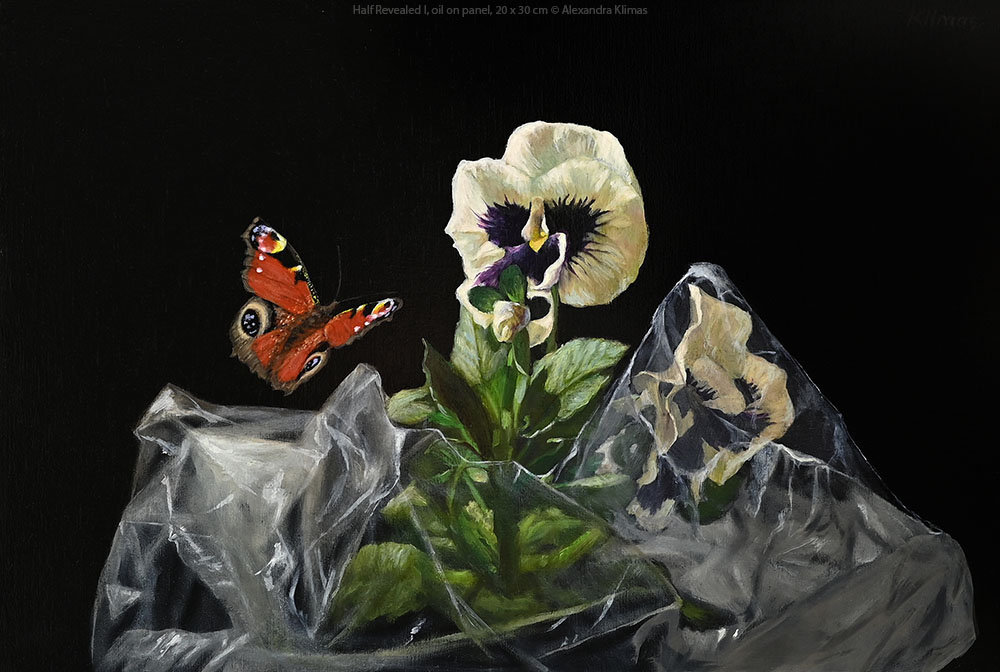
The image of pansies partially trapped within plastic packaging refers to an everyday scene: the purchase of flowering plants from a garden center.
Pansies exist at the intersection of nature, food, and consumption. They are valued for their beauty, attract pollinating insects, and are also edible. At the same time, many ornamental plants are part of intensive cultivation systems in which chemical pesticides and plastic packaging have become a routine part of production. What appears attractive to humans, butterflies, or bumblebees is not always without risk.
The butterfly and the bumblebee symbolize the vulnerability of ecosystems in which humans and animals depend on the same plants. Their presence reveals how closely our lives are intertwined with those of other species. The plastic surrounding the flowers reinforces this tension. It serves as a symbol of a society in which even living nature is packaged, traded, and consumed, while the ecological consequences often remain out of sight.
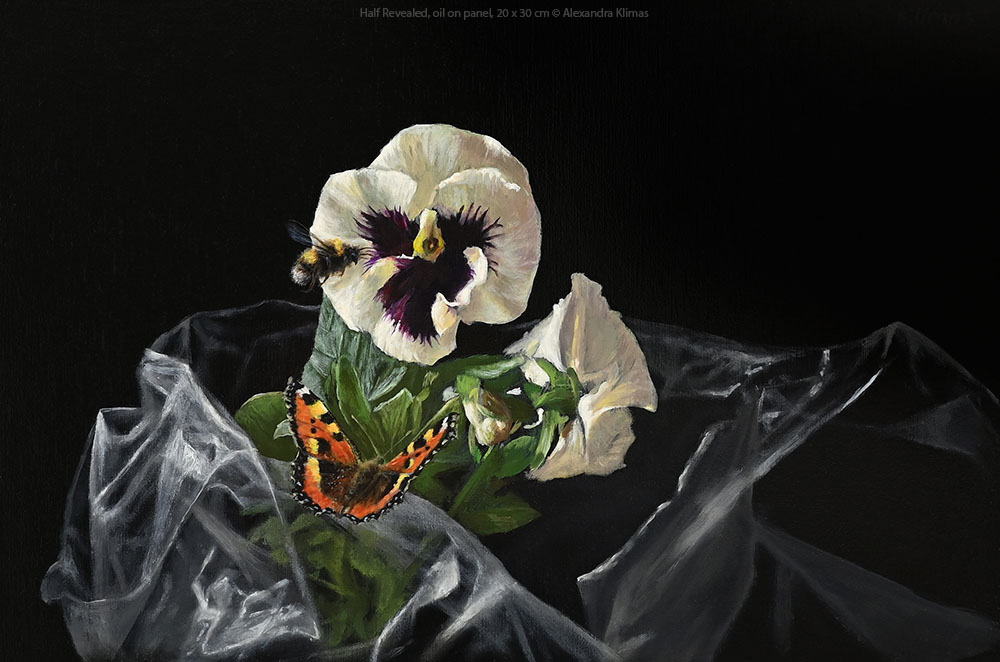
These small-scale works on panel form part of a preparatory series for larger paintings in which birds, butterflies, bees, and bumblebees form a tribute to biodiversity and to the often unseen relationships that connect all living beings.
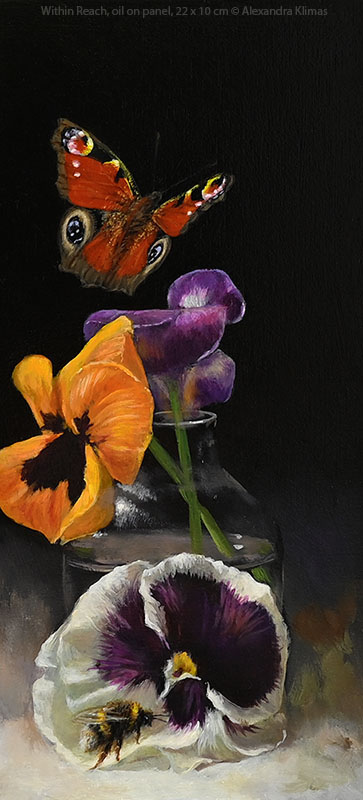
Within Reach (Binnen bereik), oil on panel, 22 x 10 cm, 2026
Pansies stand in a small flower vase, detached from their original environment and relocated into human living spaces. The flowers become an intimate and everyday object: nature brought close and appearing in a new context. A bumblebee rests on a petal, while a butterfly flutters away. The attraction is short-lived; the flower offers more beauty than nectar.
Continuing to Enjoy the Things We Love
My discovery has not changed the pleasure I take in flowers. To me, caring about nature does not mean having to give up the things we find beautiful. In fact, it is often through appreciating these things that we begin to notice and value the natural world and the insects around us even more. I will certainly continue to buy large-flowered pansies. I think they are beautiful, especially because they flower for such a long time, often throughout the winter. Their large petals and cheerful colours make them easy to see from inside my home, allowing me to enjoy their colourful blooms even on grey winter days. At the same time, I am now more aware that not all ornamental plants offer the same benefits to insects. I would therefore like to find a balance that feels right to me. For example, someone suggested placing winter-flowering heather alongside my pansies. It flowers during the winter months and can provide food for bees on milder days, when few other flowers are available. Next spring, I would also love to visit Kwekerij De Hessenhof, a special plant nursery on the Veluwe in the Netherlands. The nursery grows its plants organically, without peat, using leaf mould, and propagates its own plants. I am looking forward to discovering more about their approach and perhaps bringing home a few new plants as well.
Perhaps it all begins with small steps: continuing to enjoy the things we find beautiful while also discovering how we can make a positive difference to the natural world.
Read also: The story behind ornamental plants: gerberas
